If you are in an emergency, in crisis or need someone to talk to, there is help.

View Crisis Resources
Skip to content
  • Contact Us
  • No One Left Behind
  • Join our team
  • Referral Form
  • Virtual Urgent Care
  • Accessibility
CAMH logo
  • Patients and Families
    • Main Page
    • Access CAMH & Referral Form
      • Access CAMH

        Centralized information, intake and scheduling. Access CAMH makes it easy to find support – simply call 416-535-8501, option 2.

      • Referral Form

        For mental health services, a referral form needs to be completed by a healthcare provider. For addictions services, patient can self-refer.

    • Programs & Services
      • Addictions/Substance Use
      • Alzheimer’s & Dementia
      • Anxiety & Depression
      • Concurrent Disorders
      • Developmental Disabilities
      • Mood & Personality Disorders
      • Problem Gambling
      • Schizophrenia & Psychosis
      • Trauma & Stress Disorders
      • Virtual Mental Health and Outreach
      • Other
    • Information for Patients
      • Patient Wellness and Patient Engagement at CAMH
      • What to expect
      • Your Rights
      • Patient and Family Feedback
      • Visiting CAMH

        Planning on visiting CAMH? Find contact information, directions and accessibility for each of our three main sites.

    • Information for Families
      • Family Resource Centre
      • Patient and Family Feedback
      • Visiting CAMH

        Planning on visiting CAMH? Find contact information, directions and accessibility for each of our three main sites.

    • Patient and Family Feedback
    • Patient and Family Engagement
      • Patient and Family Partners Program
      • Information and resources
      • Get Involved in Research
      • Volunteer at CAMH
    • Visiting CAMH
      • Visiting CAMH

        Planning on visiting CAMH? Find contact information, directions and accessibility for each of our three main sites.

        Read More
    • MyCAMH
  • Health Info
    • Main Page
    • Mental Illness & Addiction Index
      • Conditions & Disorders
      • Medication Therapies
      • Substance Use
      • Types of Treatment
      • Information in Other Languages
    • Mental Health 101
      • Mental Health 101

        Use this series of free online tutorials as the starting point to learn about and understand a wide range of mental health topics.

        Read More
    • Guides & Publications
      • Community Resource Sheets

        Each of these community resource listings includes information about various services offered outside of CAMH and how to contact the relevant agency, what services they offer and for who, and what if any kind of referral is needed

        Read More
    • Crisis Resources
      • Crisis Resources

        If you are in an emergency, in crisis or need someone to talk to, there is a list of resources available for areas in and around Toronto.

        Read More
    • CAMH Store
      • CAMH Store

        The CAMH Store offers a wide array of mental illness and addiction resources for patients, families, students and professionals. Search or browse our catalogue of brochures and booklets, textbooks, manuals and assessment tools.

        Read More
    • CAMH Library
      • CAMH Library

        Open to professionals and the general public, our comprehensive resources and services support and enhance CAMH's research and clinical programs, and they facilitate learning, dynamic knowledge exchange and health promotion initiatives.

        Read More
    • Workplace Mental Health Playbook
    • Mental Health and the COVID-19 Pandemic
      • Coping with stress & anxiety
      • Quarantine & isolation
      • Stigma and prejudice
      • Loss, grief and healing
      • Covid-19 Resources for Health Care Workers
  • Research
    • Main Page
    • Research to Drive Change
    • The Discovery Fund
      • The Discovery Fund

        Fuelling the next generation of groundbreaking research and innovation dedicated to finding the causes of and cures for mental illness.

        Read More
    • Research Centres
      • Azrieli Adult Neurodevelopmental Centre
      • Azrieli Centre for Neuro-Radiochemistry
      • Brain Health Imaging Centre
      • Centre for Youth Bipolar Disorder
      • Cundill Centre for Child and Youth Depression
      • Institute for Mental Health Policy Research
      • Krembil Centre for Neuroinformatics
      • Slaight Family Centre for Youth in Transition
      • Tanenbaum Centre for Pharmacogenetics
      • Temerty Centre for Therapeutic Brain Intervention
      • The Margaret & Wallace McCain Centre for Child, Youth & Family Mental Health
    • Clinical Divisions
      • Addictions Division
      • Adult Neurodevelopmental and Geriatric Psychiatry Division
      • Child and Youth Psychiatry Division
      • Forensic Psychiatry Division
      • General and Health Systems Psychiatry Division
      • Psychology Division
      • Schizophrenia Division
    • Find a Study
      • Participate in Research - FAQs

        Answers to frequent questions about joining a CAMH study, including how to sign up, what's involved, and how we protect your rights and confidentiality.

    • Koerner Centre for Research Training
      • Koerner Centre for Research Training

        Each year CAMH provides opportunities to the next generation of scientists: today’s undergraduate students, graduate students and postdoctoral researchers. Train in a unique learning environment and help contribute to the breakthrough mental health research and treatments of tomorrow

        Read More
    • Research Services and Initiatives
      • Brain Health Databank
      • Clinical Trials Unit
      • Digital Innovation Hub
      • Ethical Use of Animals in Research
      • Industry Partnerships and Technology Transfer Office
      • North Star Initiative
      • Research Engagement at CAMH
      • Research Ethics
    • Science & Research Staff Directory
      • Our Scientific Staff
      • Research Chairs at CAMH
    • Subscribe to Brain Buzz
  • Education
    • Main Page
    • The CAMH Global Learning Academy
      • Find the Course That's Right for You

        Browse our entire selection of certificate programs, webinars and workshops.

    • TIDES
    • Student Centre Home
    • Simulation Centre
      • Simulation Centre
      • SIMposium of Minds
    • Professionals in Training
      • Clinical Psychology Training Programs
      • Community-Based Research Fellowship
      • Graduate & Post-Doctoral Fellowships in Public Health Policy
      • Clinical & Research Opportunities for Professionals in Training

        Study in a world-class setting to become a leader in the field of mental health.

    • Research in Education
      • Academic & Education Research Excellence
      • Health Equity and Inclusion Framework for Education and Training
    • Evaluation
    • Workplace Mental Health Workshops and Consulting
    • Collaborative Learning College
  • Professionals
    • Main Page
    • Treating Conditions & Disorders
      • Adult ADHD
      • NAVIGATE - Treating Psychosis in Youth
      • CARIBOU - Treating depression in youth
      • Alcohol Use
      • Anxiety Disorders
      • Bipolar Disorder
      • Dementia
      • Depression
      • Suicide Risk
      • Fundamentals of Addiction
      • Intellectual & Developmental Disabilities
      • OCD
      • Opioid use and opioid use disorder
      • Perinatal Mood & Anxiety Disorders
      • Personality Disorders
      • Psychosis
      • Posttraumatic Stress Disorder
      • Sleep Disorders
      • Smoking Cessation
      • Virtual Mental Health
    • Projects
      • Climate Change and Mental Health
      • Health Care Access Research and Developmental Disabilities
      • Immigrant and Refugee Mental Health Project
      • Opioid Use in Primary Care Conference 2024
    • Networks
      • Psychiatry Partnerships with Northern Communities
    • Clinical Tools
    • Videos
    • Podcasts
      • Quick Takes

        A podcast for physicians, by physicians. Get your clinical education on-the-go.

    • Covid-19 Resources for Health Care Workers
  • Get Involved
    • Main Page
    • Ways to Donate
      • Give Monthly
      • Give In Memory or In Honour
      • Start a Fundraiser
      • Gifts of Celebration
      • Leave a Gift in Your Will
      • Employee Giving
      • Donate Goods & Services
      • Gifts of Securities
      • Canvassers & Callers
      • Make a one-time donation

        With your support, CAMH researchers are revolutionizing the ways we diagnose, treat, and prevent mental illness. Donate today.

    • Join the Cause
      • Corporate Partnerships
      • Business Leaders for Mental Health
      • CAMH Engage
      • womenmind
      • Visionary Society
      • Michael Wilson Society
      • Volunteer at CAMH
    • Making a Real Impact
      • Making a Real Impact

        Real stories of courage, hope and discovery. Made possible through your continued support of CAMH.

        Read More
    • The Role of the Foundation
  • Driving Change
    • Main Page
    • About CAMH
      • Leadership Team Directory
      • Performance & Accountability
      • The Role of CAMH Foundation
      • For Our Neighbours
      • For Reporters
      • Events Calendar
      • Contact CAMH
      • Careers at CAMH

        By working at CAMH, you can help people affected by mental illness and support their recovery. Join the team. Everyone who works at CAMH becomes an advocate for mental health.

    • The Crisis is Real
      • The Crisis is Real

        We are in the grips of a crisis that ruins health, threatens lives and hurts economies. Knowing the facts is the first step in creating hope.

      • Mental Health Statistics

        The latest facts and statistics on mental illness and addiction, who's affected and their impact on Canadians.

    • Addressing Stigma
      • Addressing Stigma

        Challenging the stigma associated with mental illness takes understanding, education and a closer look at our own attitudes toward health.

        Read More
    • The Mental Health Facility of the Future
      • The Mental Health Facility of the Future

        Turning what was once a walled institution into a symbol of hope for the future of mental health care.

      • Vision & Guiding Principles

        How do you replace an institution with an urban village? Lots of planning, imagination and a long-term commitment to serving patients, staff and the community.

      • History of Queen Street Site

        Our history—evolving from an asylum into a modern health facility with patients at the centre of care—is the history of mental health care in Canada.

    • Influencing Public Policy
      • Influencing Public Policy

        CAMH advocates for policies that are responsive to the needs of people with mental illness and addictions.

        Read More
    • Health Equity
      • Health Equity

        CAMH believes in the principle of equity. We respect the diversity of the individuals and communities we serve.

        Read More
    • Shkaabe Makwa
    • CAMH News & Stories
    • Strategic Plan
    • Contact Us
    • No One Left Behind
    • Join our team
    • Referral Form
    • Virtual Urgent Care
    • Accessibility
CAMH Guides & Publications
Supporting a Family Member with Schizophrenia

CAMH Logo
  • Supporting a Family Member with Schizophrenia
Back to top
  • Home
  • Health Info
  • Guides & Publications
  • Supporting a Family Member with Schizophrenia

Supporting a Family Member with Schizophrenia: Practical Strategies for Daily Living
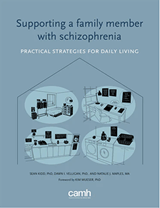
Supporting a Family Member with SchizophreniaSean Kidd, Dawn I. Velligan, Natalie J. Maples

Foreword by Kim Mueser

Supporting a Family Member with Schizophrenia is a practical guide for families and other caregivers. The support strategies in the manual can help people with the illness to really engage in life—to be able to work, study, enjoy their leisure time and have meaningful relationships.

Topics in the manual include:

  • developing a plan for introducing strategies to your relative
  • suggestions for how to get started
  • devices for recording and tracking your relative’s progress
  • recommended supports—everything from reminder signs to calendars, checklists, alarms and other simple devices—displayed in illustrations of the home
  • ideas for how to set up supports within the home—in the bathroom, bedroom, living and eating areas.

See the Cognitive Adaptive Training section on camh.ca for more. 
  

About the Authors

Dr. Sean Kidd is a clinical psychologist at CAMH and a clinician scientist in CAMH’s Complex Care and Recovery Program. He is also Associate Professor in the Department of Psychiatry at the University of Toronto. Dr. Kidd’s career has focused on research to improve services for people who are marginalized, particularly homeless youth and people with severe mental illness. He has been recognized internationally for his research into youth homelessness and for his extensive work in developing and testing psychiatric rehabilitation interventions for psychosis.

Dr. Dawn Velligan is a professor in the Department of Psychiatry and chief of the Division of Community Recovery, Research and Training at UT Health San Antonio. Dr. Velligan’s internationally recognized research program focuses on developing and testing psychosocial treatments to improve functional outcomes in schizophrenia. She developed Cognitive Adaptation Training (CAT) as a unique form of treatment designed to help people with schizophrenia bypass the cognitive impairments associated with their illness and improve their overall functioning. Dr. Velligan has received grant funding from the National Institute of Health, from The National Alliance for Research on Schizophrenia and Depression, and from industry and private foundations.

Natalie Maples is a faculty specialist in the Department of Psychiatry, Division of Community Recovery, Research and Training at UT Health San Antonio. She has implemented CAT for people leaving an institutional setting and has trained thousands of clinicians around the world. She adapts psychosocial treatments developed within their division to special populations (e.g., medically fragile, elderly, people frequently hospitalized for mental illness) and has supervised therapists for nearly two decades.
  

Testimonials

"When my daughter developed schizophrenia in her late teens, it was an overwhelming time for our family. Fortunately once she was out of hospital, the CAT approach described in this guide helped her regain her confidence and get back into the swing of life. This guide is full of excellent tips, checklists, ideas and pictures—laying out clearly the simple steps to help your loved one get on the path to their goals."   —Louise Elder, mother 

"Schizophrenia is a serious mental illness that can have life-altering effects on the individual and his or her family. In spite of these challenges, people with schizophrenia are capable of recovering a life of dignity, contributing to society and enjoying close relationships with others. Families have a reason to celebrate with the publication of this practical guide, a powerful tool for supporting the self-determination and independence of a loved one with schizophrenia or another mental illness."   —Kim Mueser, Clinical Psychologist and Professor, Center for Psychiatric Rehabilitation, Boston University 

"This unique guide can help families work in tandem with their relative to make manageable changes to improve day-to-day functioning. Step-by-step instructions provide a variety of tools and strategies to help people living with schizophrenia be more autonomous by setting and working toward their own goals. With a strong emphasis on two-way communication, this guide can help families achieve a stronger and healthier family dynamic."   —Mary Alberti, Chief Executive Officer, Schizophrenia Society of Ontario.

This product is available in English only.

Ce produit est offert en anglais seulement.

You may also be interested in 

Order a copy of Supporting a Family Member with Schizophenia from the CAMH Store 

Cognitive Adaptation Training 

Psychosis Overview  

To access treatment at CAMH: Access CAMH

Slaight Centre Early Intervention Service
An outpatient program for young people experiencing a first episode of psychosis and their families.

Early psychosis: An Information Guide

Promoting Recovery from First Episode Psychosis: A Guide for Families

Women and Psychosis: An Information Guide 

When a parent has experienced psychosis: How to talk to kids

When a parent has experienced psychosis: Answers for kids 

Treating Conditions & Disorders: Psychosis

CAMH Education videos: The causes of psychosis with Dr. Kwame McKenzie

Patient and Family Learning Space

Patient and Family Engagement at CAMH


Can we count on your support?​

Donate to help us improve mental health care for everyone.

Follow us
  • Patient and Family Care
  • Health Info
  • Science and Research
  • Education
  • Professionals
  • Get Involved
  • Driving Change
  • About CAMH
  • Job Openings
  • Purchase Publications
  • Referral Form
  • For Reporters
  • Donor Services
  • Events

CAMH Switchboard

From the GTA: 416 535-8501


Toll-free: 1 800 463-2338

To Access CAMH Clinical Services

416 535-8501, press 2

We have multiple locations. Find directions.

Map of CAMH's Queen Street Site
  • Staff Tools

Copyright 2026 CAMH

  • Terms of Use
  • Accessibility
  • Site Map

Keep in touch with CAMH

Keep your finger on our pulse – latest CAMH news, discoveries and ways to get involved delivered to your inbox.

Please select a newsletter

Please complete the following:

    Required Fields

    Please select a newsletter option

    Please input a first name

    Please input a last name

    Please input an email address

    By clicking Sign Up below, I consent to receive electronic communications (as selected above) from CAMH and CAMH Foundation. To unsubscribe at any time click the link in our mailing or email: unsubscribe@camh.ca

    Please agree to the Terms of Use


    Thanks for Subscribing.

    We look forward to keeping you informed, inspired and involved in all things CAMH.

    Help us change mental health care forever.

    Every donation moves us closer to a future where no one is left behind.

    $
    Other Ways to Give